Real-World Applications of AI in Manufacturing and Warehousing
Whenever I talk to operations leaders, I find there is still an incredible amount of meat left on the bone when it comes to utilizing AI. This isn’t just future tech for silicon valley; global enterprise companies are using these mathematical tools right now to save millions. Today, I want to walk you through proven case studies showing exactly how an AI layer on top of WMS architectures can optimize your throughput, labor, and transportation.
Proven Supply Chain AI Use Cases
When we look across manufacturing, warehousing, and procurement, math is actively driving substantial bottom-line value:
- Manufacturing Yields: I always look to AB InBev as a premier example. They leveraged reinforcement learning—constantly analyzing sensory data like temperatures and pressures—to tune their control systems in real time. The result? A staggering 60% increase in barrelage per filtration run.
- Vision-Based Inspection: Nestle took high-resolution frame-by-frame cameras along their manufacturing lines and paired them with deep learning. They jumped from an 85% baseline to 99% plus defect detection accuracy at high speeds.
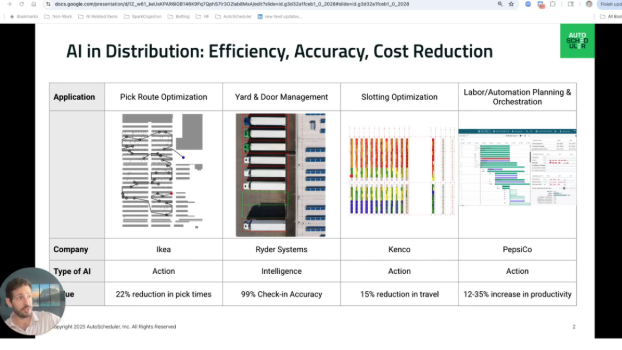
- Pick-Route Optimization: In retail fulfillment, companies like IKEA use optimization math to batch trips and route pickers through the facility, drastically cutting down travel time and maximizing floor productivity.
How We Help Brands Master Labor Optimization
One of the highest-value areas for action-oriented AI is inside the warehouse walls, dealing with labor scheduling and orchestration. Take a look at a massive consumer goods brand like PepsiCo. They handle highly complex operations with changing customer orders, manual processes, and automated flows.
Watch PepsiCo’s Webinar : From Framework to Action: Decision Automation in the Agentic Supply Chain
When trucks don’t show up on time and labor schedules break down, they can’t rely on static plans. They use an intelligent layer that sits directly on top of their warehouse management and transportation systems to pull in real-time trailer locations, inventory levels, and constraints. It constantly provides a perfect live playbook, telling the site exactly what work to execute, when to do it, and how many people are needed where. That is the true power of advanced warehouse labor scheduling software and CPG warehouse optimization.
Tired of constant warehouse firefighting and losing your best talent to systemic burnout? Download my deep-dive whitepaper, The High Cost of Labor Firefighting and Systemic Attrition, and discover how to transition your operations from chaotic daily reactive planning to automated, stable profitability today.
My Advice for Personal Workplace Productivity
If you aren’t deploying AI to multiply your own team’s day-to-day output, you are falling behind. Here are three simple workflows I implement inside my own workday:
- Record and Search Meetings: We have a corporate-wide meeting recording policy. It makes the core intent of every customer and internal conversation infinitely searchable.
- Excel Formula Accelerators: Stop spending hours manually troubleshooting spreadsheet errors. Use LLMs to generate complex macros and formulas by simply describing the business outcome you want.
- Jargon Translation: Whenever my team of PhDs sends me highly technical optimization algorithms, I use AI to translate it into an “explain like I’m 5” summary so I can immediately weigh the commercial impact.
Ready to bridge the gaps in your distribution framework? Watch part two of my series here: https://www.youtube.com/watch?v=6AO1Rpo6Ke4