In food and beverage (F&B) logistics, operational friction isn’t an execution problem; it is a decision overload problem. Short shelf lives, constant production shifts, volatile customer demand, and unforgiving retail compliance windows create an environment of continuous disruption.
While traditional Warehouse Management Systems (WMS), Enterprise Resource Planning (ERP), and Manufacturing Execution Systems (MES) excel at tracking transactions and recording inventory, they operate in strict data silos. They lack the native capacity to dynamically coordinate real-time tradeoffs across manufacturing lines, available labor, dock scheduling, and expiration risks.
When a production line changes over or a carrier arrives late, static daily plans shatter. Warehouse floor managers are left “firefighting”, manually shuffling paper, re-sequencing dock doors, and guessing at labor allocations using spreadsheets and tribal knowledge.
To break this cycle, forward-thinking F&B brands are shifting away from static software models. Instead, they are integrating a real-time warehouse execution system AI layer that acts as an operational brain on top of their existing tech stack to optimize the next 24 to 36 hours.
4 Critical Challenges Facing F&B Warehousing
Inside a single shift, fresh product lifecycles, production variability, carrier volatility, and retail compliance windows collide. This friction creates four systemic bottlenecks:
1. The Freshness vs. Inventory Trap
F&B operations function under unforgiving FIFO (First-In, First-Out) or FEFO (First-Expired, First-Out) rules. When inventory tracking and dock scheduling are disconnected, high-velocity perishables sit stagnant for too long. This disconnect results in severe margin loss through scrap, spoilage, or rejected retail shipments.
2. Severe Dock & Yard Congestion
Uncoordinated carrier arrivals, unoptimized door assignments, and fluctuating cross-dock opportunities cause trailers to back up in the yard. The results are cascading driver detention fees, yard gridlock, and missed customer On-Time, In-Full (OTIF) targets. Overcoming this requires purposeful dock scheduling optimization to orchestrate seamless yard-to-dock flows.
3. The Production-to-DC Blindspot
Production lines constantly shift schedules based on raw ingredient availability or plant constraints. Meanwhile, distribution centers struggle to anticipate exactly what inventory will hit the staging area and when. This gap leads to constant staging congestion or missed orders.
4. The Volatility of “Tribal Knowledge”
Daily operations frequently rely on a few key personnel (the “quarterbacks” or “taskers”) using unwritten rules and mental math to run the floor. This manual approach cannot scale, cannot adapt instantly to changing conditions, and leaves the operation incredibly vulnerable to human error and labor turnover.
The Solution: A Real-Time Decision Intelligence Layer
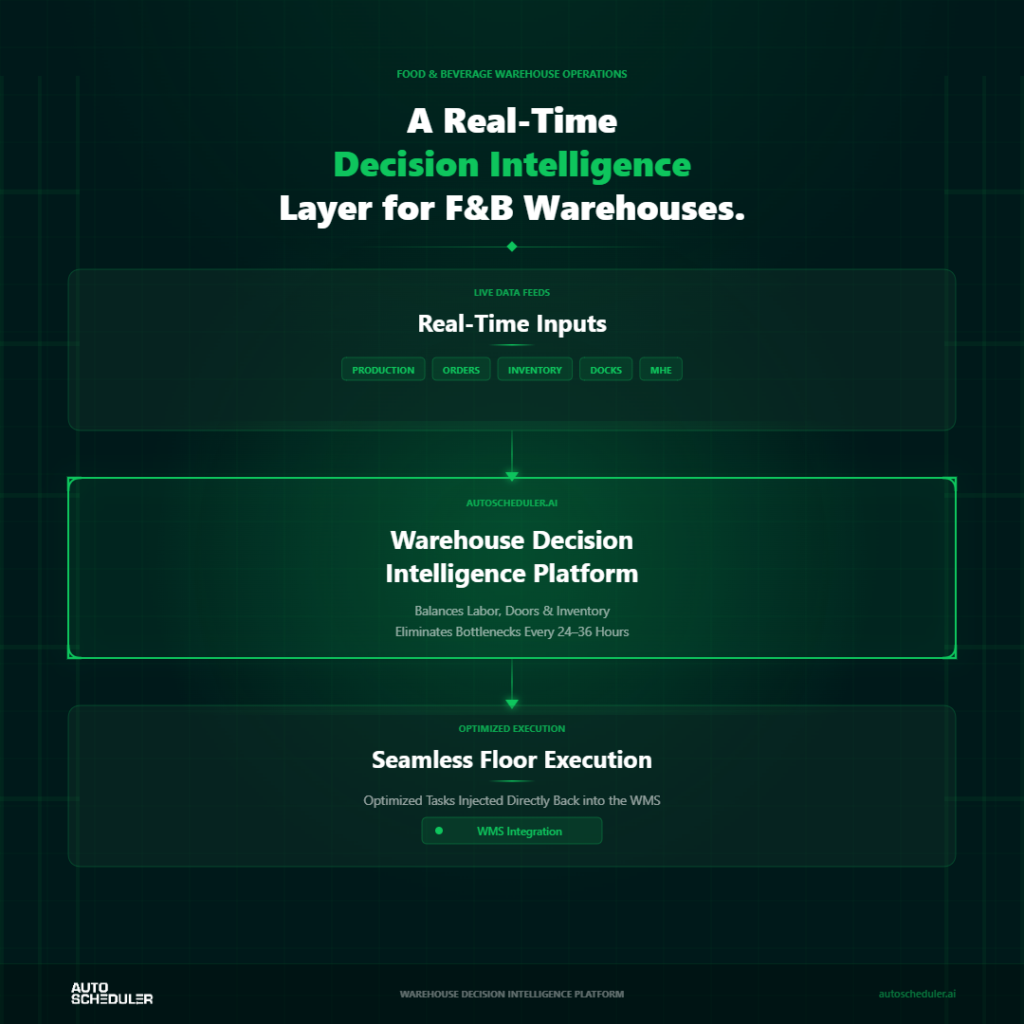
Rather than engaging in a costly, disruptive system “rip-and-replace,” enterprises deploy warehouse decision software directly over their transactional infrastructure. This platform continuously reads real-time inputs—including production outputs, orders, inventory levels, docks, and Material Handling Equipment (MHE)—and writes optimized, interleaved tasks directly back into the WMS.
By introducing agentic AI for warehouse operations, facilities can automate the continuous orchestration loop across three key pillars:
- Yard & Dock Synchronization: Dynamically sequences trailers and assigns optimal dock doors to minimize cross-facility travel distance, eliminate bottlenecks, and accelerate high-velocity inventory flow.
- Dynamic Labor Balancing: Continuously aligns tasking with actual labor capacity. Floor managers can reliably plan 24 to 48 hours ahead using straight-time, minimizing costly, reactive overtime.
- WMS Acceleration: Acts as the decision intelligence layer for your existing WMS. It continuously reads constraints and coordinates work batches back into the system for seamless floor execution.
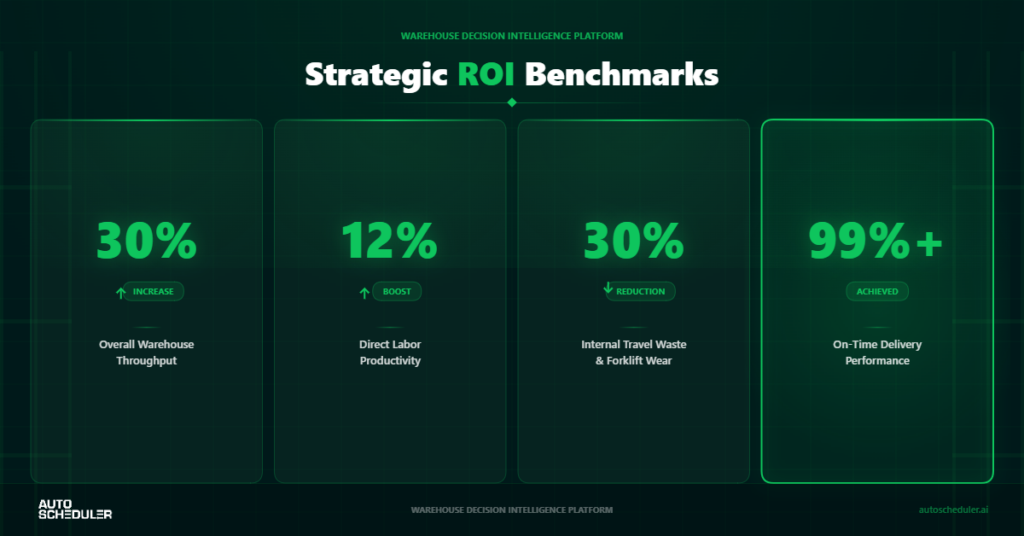
Proven Network Performance Benchmarks
Transitioning from manual planning to predictive, math-driven flow yields definitive, measurable ROI across complex consumer networks:
Enterprise Case Studies: Math-Driven Execution at Scale
Case Study 1: High-Velocity Inventory Synchronization
Operating at a massive scale, a leading global beverage enterprise integrated AutoScheduler to address high-velocity inventory synchronization. By deploying a decision intelligence framework on top of their transactional systems, they shifted operations from manual, reactive firefighting to optimized, autonomous flow.
The implementation unlocked a seamless operational rhythm between production outputs, yard moves, and dock sequencing. Across their network, they captured a 9% year-over-year improvement in Commercial Pallets Per Hour (CPPH), with a 19% CPPH boost achieved specifically at their primary pilot facility.
Case Study 2: Standardizing the Network Blueprint
During a high-stakes corporate spinoff, a major North American packaged foods enterprise utilized AutoScheduler across its distribution network to replace tribal knowledge with standardized, math-driven execution.
By utilizing automated warehouse labor scheduling software to gain a predictable 24-to-48-hour view of operational visibility, the organization drove a 9% to 14% reduction in overtime spend while sustaining average productivity gains across every facility in the network.
Protect Freshness, Maximize Throughput
Relying on manual workflows or static WMS rules in a volatile market is a liability. To mitigate warehouse labor shortages, cut trailer detention fees, and shield margins from spoilage, F&B operations must adopt predictive execution. Introducing advanced warehouse labor planning software and constraint-based decision intelligence ensures your facility operates at maximum efficiency, protecting your inventory, your labor, and your margins.
[ Download the Food & Beverage Case Study ]
https://autoscheduler.ai/wp-content/uploads/2025/11/AUS-2025-Case-Study-AI-Driven-Flow.pdf