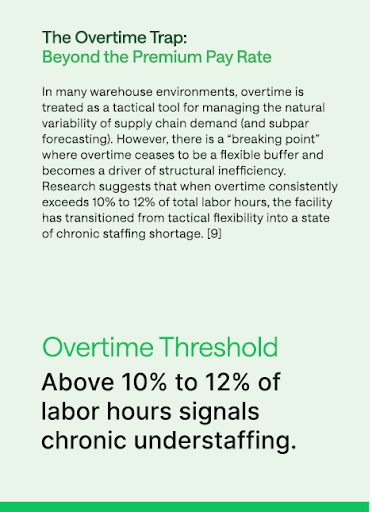
Overtime feels like a safety valve in warehouse operations. Volumes spike, people stay late, and the shift gets through the backlog. But research shows a clear breaking point. When overtime consistently exceeds 10% to 12% of total labor hours, the operation is no longer flexible. It is structurally understaffed.
This is where Centralized Warehouse Orchestration becomes critical, because overtime is not really a labor problem. It is a planning and decision problem.
The Productivity and Fatigue Paradox
It is tempting to assume that more hours mean more output. In reality, the opposite is often true:
- Productivity per hour drops sharply after 50 hours per week
- 60 hour weeks often produce less total output than 40 hour weeks
- Injury risk rises significantly with extended shifts
- Burnout increases absenteeism and turnover
From a warehouse efficiency standpoint, chronic overtime means you are paying more for less.
Why Overtime Becomes Structural
Facilities do not rely on overtime because they want to. They rely on it because:
- Plans are static
- Execution is dynamic
- Decisions are made manually across siloed systems
This is another symptom of warehouse management system limitations. A WMS can tell you what tasks exist. It cannot continuously rebalance labor in real time as conditions change. Watch: What Your WMS Was Never Built To Do
So managers use overtime as a buffer. Over time, that buffer becomes the system.
How Orchestration Replaces Overtime as the Safety Net
An Intelligent Warehouse Orchestration Platform changes how capacity is managed day to day. Instead of relying on overtime to absorb every disruption, the operation continuously adjusts the plan as conditions change.
In practice, that means the system:
- Monitors execution in real time
- Reprioritizes work based on service risk and business impact
- Reallocates labor before small problems become big ones
- Increases decision velocity instead of extending shifts
This is what decision automation looks like in real operations. Overtime returns to what it should be: a tactical exception, not a permanent crutch.
The Bottom Line
If overtime is baked into your normal plan, you do not have a labor problem. You have a decision problem. Better decisions beat longer hours every time.
Download the Whitepaper to see the data, the math, and the full framework for moving from labor chaos to orchestrated operations. Download the Whitepaper→