I have been deploying advanced algorithms in the supply chain space for over a decade, and if there is one thing I know for certain, it’s this: software is easy, people are hard. The technology is rarely your biggest roadblock to achieving a high ROI; it is almost always your strategy and change management. Today, I want to give you my personal blueprint for scoping a successful AI project, avoiding systemic traps, and mathematically proving value to your board.
My Baseline Rule for Scoping an AI Project
When an operations leader asks me if their problem is a good fit for AI, I give them a simple test. If you could put an intelligent person in a closed room with all the data in the world and an infinite amount of time, and they could successfully complete that project—then that is a workflow we can replicate, enhance, and optimize with artificial intelligence.
Your data and your choices must be robust enough for the mathematics to build upon. This is why standard rule-based vs AI warehouse optimization models fall short; rigid, static “if-then” logic simply cannot handle the fluid, chaotic nature of a modern supply chain. You need a dynamic warehouse execution system AI that continuously learns and recalculates as conditions change.
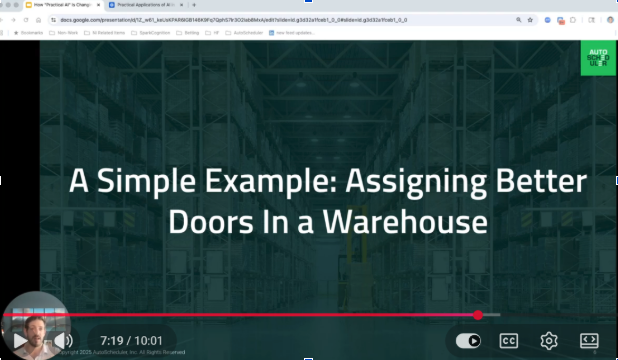
Maximize your deployment success by watching the final chapter of my strategy roadmap here: https://www.youtube.com/watch?v=IfR13bOFDms
Implementation Traps to Avoid
Before you kick off an automation initiative, watch out for these two critical missteps:
- Replicating Historical Biases: Your models will learn from your past data. I always cite Amazon’s early resume-filtering algorithm, which mistakenly automated and enforced gender hiring biases simply because it trained on historical company data.
- Cutting the Change Management Budget: When project costs get tight, executives always slash change management first. This is a massive mistake. If you don’t get top-to-bottom organizational buy-in and assure your floor team that AI is there to make them more effective—not just replace them—your rollout will fail.
The Math of ROI: My Forklift and Dock Door Framework
You must look at an AI deployment through the exact same lens as a math project—by identifying direct value drivers. Let me map out a simple example regarding dock scheduling optimization to prove how small efficiencies translate to massive annual returns:
Imagine a standard consumer goods warehouse. If your trailer parking configuration is unoptimized, your forklifts travel an average of 100 additional feet per pallet just to get to an inefficiently assigned dock door.
- A typical CPG site moves about 52 pallets per shipment.
- They run roughly 45 shipments per day.
- That equals 234,000 additional feet of wasted travel every single day.
If a standard forklift travels at 6 mph, that site is incurring 7.44 hours of completely wasted travel time per day. At a modest $25 hourly wage, that single unoptimized operational node is draining nearly $70,000 a year, per facility.
When you scale that math across a multi-site network, implementing an automated solution isn’t just a tech upgrade—it is a critical necessity for warehouse labor shortage solutions and trailer detention cost reduction.
Ready to turn these mathematical returns into your reality? You don’t have to build these algorithms from scratch, we have already put everything in place for you within our Warehouse Decision Intelligence platform. Click here to book a personalized demo: https://info.autoscheduler.ai/book-a-demo and let’s start pulling wasted dollars straight back into your bottom line.