In high-velocity consumer packaged goods (CPG) logistics, the floor environment is inherently chaotic. Supply chain leaders face a constant barrage of production schedule volatility, fluctuating retailer demands, and strict order fulfillment windows.
While traditional enterprise systems, such as your Warehouse Management System (WMS), Enterprise Resource Planning (ERP), and Manufacturing Execution System (MES), are excellent at recording transactions, they operate in strict data silos. They lack the capacity to dynamically coordinate real-time tradeoffs across manufacturing lines, available labor, dock scheduling, and off-site storage networks.
When a production line changes unexpected variants or an off-site shuttle lags, static daily plans shatter by mid-shift. Managers are left manual firefighting, using spreadsheets, memory, and tribal knowledge to keep lines running and trailers moving.
To overcome this, modern logistics operations are turning to next-generation warehouse decision software powered by agentic AI for warehouse operations to act as a real-time operational brain on top of their existing tech stack.
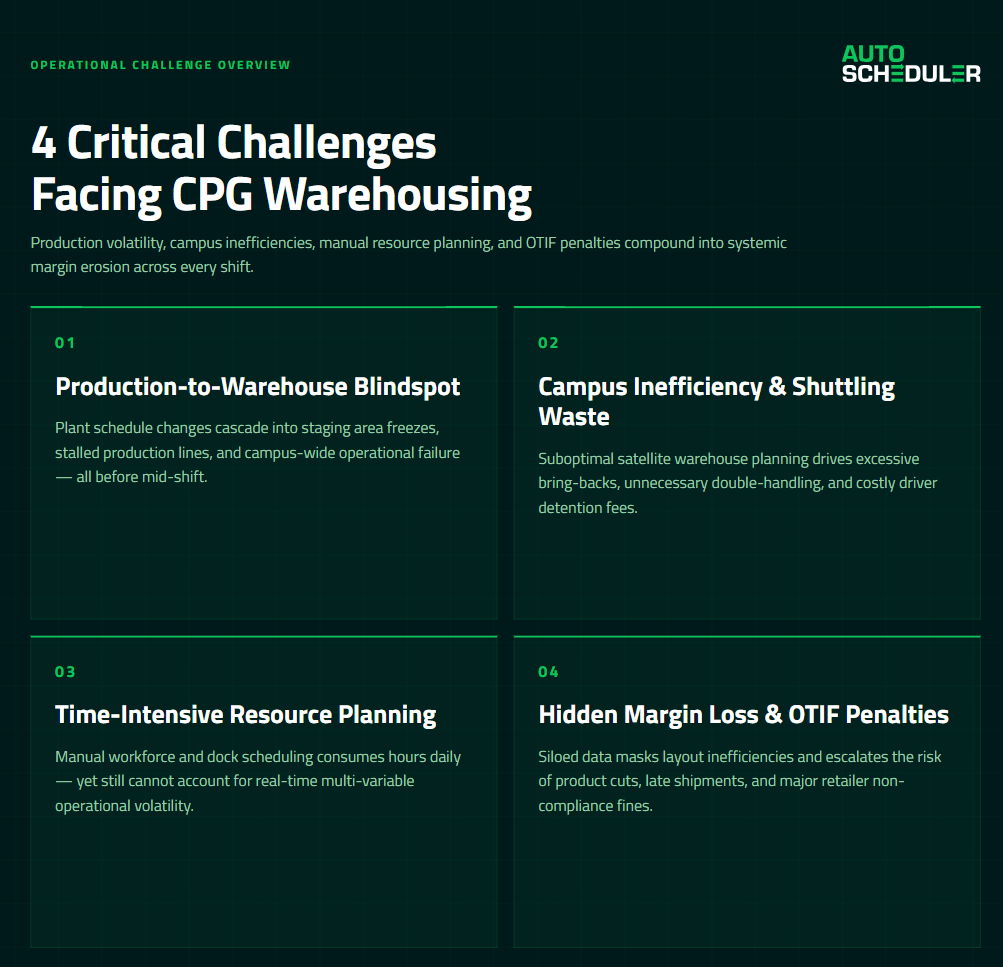
4 Critical Challenges Facing CPG Warehousing
Inside a single shift, production volatility, off-site shuttling, resource planning, and retailer compliance frequently collide. This friction exposes four systemic bottlenecks:
1. The Production-to-Warehouse Blindspot
Plant schedules change constantly due to raw material shifts, line constraints, or labor availability. When the attached warehouse cannot instantly adapt, staging areas freeze up, product lines stall due to delayed raw component delivery, and massive operational inefficiencies cascade across the campus.
2. Campus Inefficiencies & Off-Site Shuttling Waste
Due to space limitations at manufacturing facilities, CPG firms rely heavily on local network satellite warehouses. Suboptimal planning leads to excessive double-handling, expensive driver detention fees, and an over-reliance on “bring-backs”, unnecessarily shuttling finished goods from satellite locations back to the plant just to fulfill a single outbound load. Implementations that focus on dock scheduling optimization are critical to achieving a sustainable trailer detention cost reduction.
3. Time-Intensive & Error-Prone Resource Planning
Industrial engineers and site managers spend hours every single day manually piecing together complex workforce and task schedules. Without dedicated warehouse labor scheduling software, these manual efforts cannot account for multi-variable volatility in real time, resulting in unbalanced labor zones, high overtime expenses, and underutilized dock doors.
4. Hidden Margin Loss & Retailer Penalties
Siloed operational data makes it difficult to uncover underlying systemic layout inefficiencies. Disconnected logistics workflows heighten the risk of product cuts, order substitutions, late carrier departures, and missed shipments, directly triggering severe On-Time, In-Full (OTIF) non-compliance penalties from major retail buyers.
The Solution: A Real-Time Decision Layer
Rather than replacing your core infrastructure, a warehouse execution system AI layer like AutoScheduler overlays seamlessly onto your existing WMS, ERP, and MES architecture. It eliminates data blindness by unifying plant schedules, inventory locations, and carrier workflows into a single execution truth.
The platform continuously models every operational constraint simultaneously, automatically orchestrating and executing the most efficient task plans for the next 24 to 36 hours.
- Seamless Data Harmonization: Integrates siloed operational data streams into a single, unified analytical interface, giving corporate logistics, plant management, and site supervisors a singular source of truth.
- Dynamic Constraint Optimization: Evaluates real-time constraints including dock door capacity, current warehouse staging limitations, localized labor availability, and material tracking to inject perfectly balanced work batches back into the WMS.
- Intra-Campus Material Optimization: Intelligently balances direct-from-line dock shipments against satellite facility allocations, heavily cutting down cross-dock transit steps and maximizing campus trailer sequencing.
Proven Strategic Performance Benchmarks
By replacing reactive firefighting with predictive, mathematically proven facility flow, enterprises convert high-volume warehouse complexes into predictive profit drivers without requiring disruptive system overhauls.
Enterprise Case Study: Multi-Facility Flow Optimization
The Environment
A Leading Global CPG Enterprise operated a highly critical, massive manufacturing plant supported by 7 distinct nearby satellite warehouses, managing over 250 outbound truck shipments every day (85% drop-and-hook / 15% live loads). Manual scheduling and production line volatility caused severe campus travel overhead and constant product bring-backs.
The Transformation
The enterprise deployed AutoScheduler’s decision intelligence layer directly over its existing transactional tech stack to harmonize production needs with distribution workflows. By integrating automated labor allocation software and advanced dock scheduling software, the platform delivered exceptional operational improvements:
- $4M+ in Audited Total Operational Savings: Directly captured through optimized campus logistics and reduced waste.
- 96% Reduction in Labor Scheduling Time: Slashing daily workforce planning from 8 manual hours to a 20-minute automated review, significantly helping to reduce warehouse overtime.
- Increased Direct-from-Plant Dock Shipments: Accelerated from 57% to 83.4%, speeding up the factory-to-customer order cycle.
- 45.6% Reduction in Satellite Warehouse Bring-Backs: Minimizing unnecessary double-handling and lowering intra-campus transport costs.
- 30% Boost in Overall Throughput: Buffering a high-stakes inventory crunch without increasing network safety stock.
Transitioning From Reactive to Predictive Logistics
Relying on manual planning in a modern supply chain is an expensive bottleneck. To combat warehouse labor shortages and severe retail penalties, organizations must transition from rigid schedules to predictive, autonomous execution. Implementing specialized warehouse labor planning software and intelligent constraint orchestration ensures your facility flows seamlessly no matter what disruptions the next shift brings.
See How the World’s Largest CPG Brands Sync Operations
Real-time volatility requires real-time orchestration. Discover how global manufacturing footprints deploy AutoScheduler directly over their existing WMS, ERP, and MES architecture to achieve a 99% Sustained On-Time Shipment reliability metric.
Read P&G Case Study: https://autoscheduler.ai/case_study_gate/