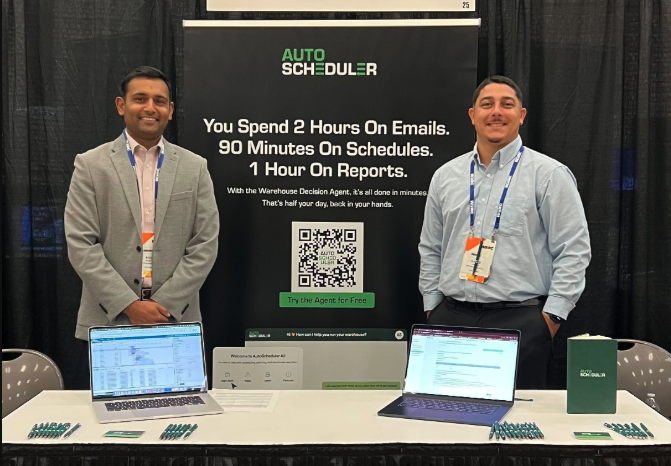
The Vibe at WERC 2025
WERC 2025 reminded me why I love this conference, it’s where people who actually run the warehouse come to talk about what’s working, what’s breaking, and what’s next.
This year, one thing stood out: there were few, if any, explicitly “AI” companies presenting or exhibiting. And that actually made sense. This audience doesn’t need more theory; they need faster time to value. Leadership teams are often already sold on AI’s potential. It’s the floor operators, coordinators, and managers who need to see it work, in real time, without disruption.
AI that Walks the Floor
One of the most interesting discussions during my session centered on AI on the warehouse floor, not as a desktop tool, but as a walking, talking companion.
We explored how Decision Agents can operate via voice and mobile devices, giving users live answers to questions like:
“Which door should I send this trailer to?”
“Which inbounds are running late?”
“What are the best loads to working now?”
This real-time interaction is transformative for two reasons:
- Freedom: Workers aren’t tethered to a desk, they can move and act as they ask.
- Data Intake: Every interaction becomes a new data pipeline, feeding the system live operational context.
That feedback loop, human to agent to system, is what turns AI from an observer into a true collaborator.
Why Dashboards Can’t Drive Real-Time Warehouse Decisions
The focus of the talk was on the move from Dashboard to decision agent, extrapolating on Keith Moore’s Forbes article.
The whole presentation is linked in the resources, but in essence, the truth is, dashboards give us visibility, but not velocity. They show what happened, not what to do about it.
Decision Agents fill that gap, taking in real-time data, modeling constraints, and actually orchestrating action.
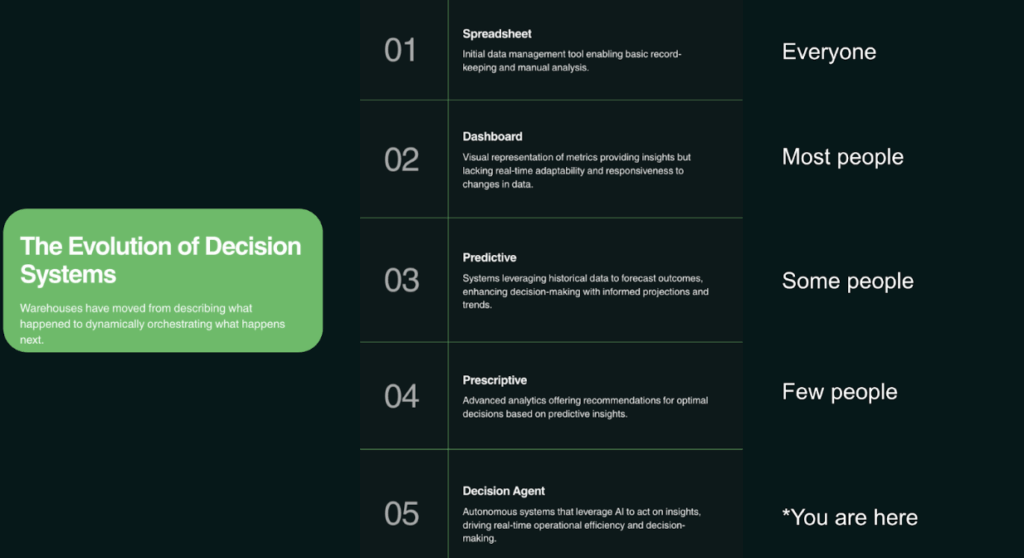
The Evolution of Warehouse Decision Systems
We traced the evolution from spreadsheets to dashboards to decision orchestration, from passive data to active direction.
Each step adds a layer of intelligence, but only Decision Agents complete the loop from insight to execution.
The Four Levels of Decision Maturity
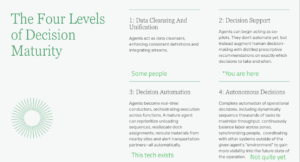
Attendees quickly found themselves in this ladder:
- Data Cleansing & Unification – Fix the plumbing first.
- Decision Support – AI as co-pilot.
- Decision Automation – AI coordinating repeatable tasks.
- Autonomous Decisions – Humans governing exceptions, not micromanaging.
Most were at Levels 1 or 2, harmonizing data and testing co-pilot-style agents. And that’s progress.
Does AI “Dumb Down” the Workforce?
A great question came from a warehouse manager in the audience:
“Does this kind of AI risk dumbing down the employee base?”
It’s a valid concern, and one I’m glad was asked.
My answer: it’s the opposite.
By offloading menial, reactive work, like chasing delayed trucks or rebalancing docks, AI frees time for the most human parts of the job:
- Checking on safety.
- Coaching newer associates.
- Strengthening team culture.
In my experience, leadership and culture still drive warehouse success more than any system ever will. Decision Agents just create the space for that leadership to thrive.
Advantages and Challenges
AI’s promise is clear, faster, more consistent, proactive operations.
But it’s not without its challenges. The biggest hurdles are trust, change management, and readiness.
As I told the audience:
“AI adoption is 10% technology, 90% human behavior.”
That’s why we focus not just on visibility, variability, and velocity, but on a fourth “V”: Validation.
The 4th V: Validation: Keeping Humans in the Warehouse AI Loop
Validation is about humans staying in the loop, ensuring decisions aren’t just correct, but right and good.
That’s the principle behind our Freemium Warehouse Decision Agent, which invites operators themselves to validate, correct, and guide the AI.
Because every piece of feedback, every interaction, makes the system, and the humans, smarter together.
My Takeaway
The most encouraging part of WERC 2025 wasn’t the technology. It was the curiosity.
Warehouse professionals weren’t asking “what is AI?” anymore, they were asking “how can I use it today?”
The future is Decision Agents that walk beside you.
And if we keep humans at the center, validating, improving, and connecting, the warehouses of tomorrow will be not just faster, but more human.
If You Missed the Session
👉 You can explore some of the ideas we discussed, and try our Freemium Decision Agent, here: autoscheduler.ai/agent-gate