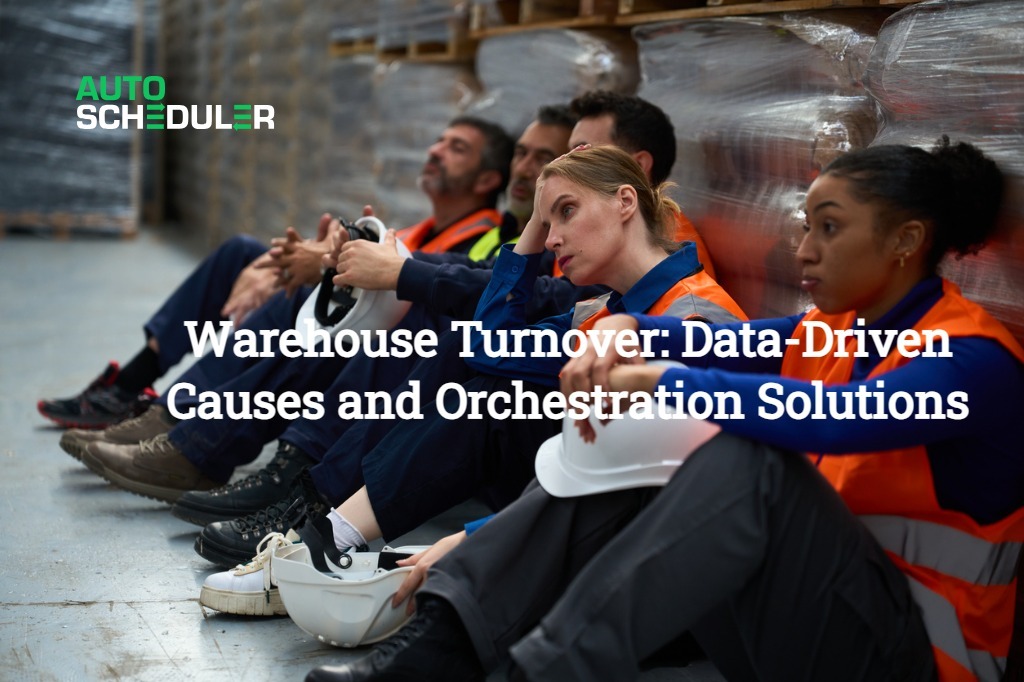
The logistics industry currently faces a critical labor crisis, with annual warehouse turnover rates averaging 40% to 60%, and exceeding 100% in high-volume fulfillment centers. Addressing this churn requires moving beyond HR strategies toward Intelligent Warehouse Orchestration.
The Economic Impact of Associate Churn
Replacing a single frontline associate incurs a total economic cost between $4,000 and $10,000. This calculation includes recruitment, onboarding, and the following hidden operational “taxes”:
- Productivity Deficit: New hires typically operate at 50% to 70% efficiency during their initial 30 days.
- Quality Variance: Inexperienced staff contribute to a 33% increase in error rates.
- Managerial Opportunity Cost: Supervisors divert time from strategic leadership to repetitive basic training.
- The Burnout Spiral: Remaining staff absorb excess workloads, leading to secondary turnover and systemic instability.
Technical Root Causes: Beyond HR
High turnover is often a symptom of systemic decision failure. Traditional Warehouse Management Systems (WMS) and static spreadsheets are unable to adapt to real-time variables such as:
- Intraday volume shifts.
- Labor call-outs and absenteeism.
- Inbound transportation delays (TMS misalignment).
When a WMS fails to provide real-time trade-off logic, managers revert to reactive firefighting, which increases workplace stress and accelerates associate exits.
Solving Turnover with Centralized Warehouse Orchestration
To break the “turnover death spiral,” operations are adopting Intelligent Warehouse Orchestration Platforms powered by Agentic AI. This technology shifts the burden of decision-making from stressed managers to autonomous systems.
Key Capabilities of Agentic AI in Logistics:
- Cross-System Sensing: Integrates data streams from WMS, LMS, and TMS to identify disruptions.
- Dynamic Labor Rebalancing: Recalculates optimal labor allocation in minutes rather than hours.
- Predictable Execution: Provides associates with clear, prioritized tasks, reducing the chaos that leads to burnout.
The Bottom Line: High turnover is a signal that your facility lacks a cohesive warehouse decision platform. Transitioning from manual firefighting to automated orchestration stabilizes the environment and preserves your most valuable asset: your people.
If your warehouse needs heroes to survive the day, your system is already broken. Turnover is not a people problem. It is a warehouse decision platform problem.
Download the Whitepaper to see the data, the math, and the full framework for moving from labor chaos to orchestrated operations. Download the Whitepaper→