Every day, I see the logistics landscape flooded with tech buzzwords, and quite frankly, sorting through the noise on social media is exhausting. My goal for this series is to strip away the marketing fluff and get rid of the BS. I want to give you a practical, straightforward look at what artificial intelligence (AI) actually means for industry professionals like us and how it’s redefining our daily operations.
The Keith Moore Definition of AI
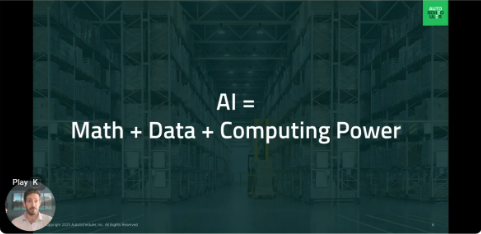
You won’t find this definition in Encyclopedia Britannica, but I like to simplify the entire concept down to a basic formula: Whenever someone tries to sell you an abstract AI solution, I want you to try my favorite piece of advice: replace the word “AI” with “math” in whatever sentence they are using and see if it sounds stupid. If someone says, “I’m going to change my life with AI,” and you change it to, “I’m going to change my life with mathematics,” it immediately sounds nonsensical. AI isn’t magic; it is advanced mathematics, combined with data you own or have access to, utilizing computing cycles (CPU/GPU) to produce a measurable outcome.
Intelligence vs. Action in the Supply Chain
When I look at AI in our space, I break it down into two distinct groups:
- AI for Intelligence: These are systems designed to help us learn and predict. They take historical data to describe your current state or predict future trends (like demand forecasting).
- Action-Oriented AI: This is where things get exciting for warehousing. This is math designed to drive real-time decisions. It inputs data, maps out your operational constraints, and dynamically decides the exact next actions your floor needs to take.
Bringing an AI Reasoning Layer to WMS
While early neural networks excel at complex visual tasks like product defect detection, the massive shift we are seeing right now is toward generative AI and Large Language Models (LLMs). By utilizing the context of the entire internet, we can now establish a true AI reasoning layer for WMS environments. This allows operators to sit in front of complex legacy data pools and query them using natural, human language to make high-fidelity decisions instantly.
Want to hear me walk through this breakdown live? Check out the full part one video here: https://www.youtube.com/watch?v=dVzqnRBwVdQ
Looking to the Future: What is Agentic AI?
We are rapidly moving past traditional, rigid warehouse orchestration and moving toward real autonomy. In my view, an “AI Agent” is an LLM that has all the context of your data, has been given specific missions, but crucially, possesses agency—the software has the ability to not only observe, orient, and decide, but also to act on your behalf within secure guardrails.
“An agent is a large language model… that has the ability to not only observe, orient, and decide… but also act.”
Whether it’s an agent I built in 30 minutes to manage my personal schedule or an enterprise warehouse labor planning software solution keeping a site optimized, agentic workflows execute tasks with the same contextual flexibility as an autonomous human operator.
Ready to see how advanced math can eliminate your daily operational firefighting? Stop letting your WMS legacy data sit idle. Try the Warehouse Decision Agent your sidekick for daily coordination. See how it handles travel waste, zoning, and labor gaps in real-time.