What Warehouse Teams Are Actually Asking Their AI Agent (And What It Reveals About Modern Operations)
When we launched the Warehouse Decision Agent last year, we had a hypothesis: warehouse operations teams were drowning in decisions that their WMS was never designed to handle in real time. What we did not fully anticipate was how quickly customers would make the agent a core part of their daily workflow, or how clearly their questions would expose the operational fault lines that rule-based systems have been papering over for years.
Since launch, we have been continuously expanding the agent’s capabilities, including explainability features that let operators understand the reasoning behind every recommendation, and voice recognition support that lets teams interact hands-free in active floor environments. What follows is a synthesis of what we have learned from real customer interactions, focused not on raw numbers but on the patterns, themes, and questions that define how warehouse professionals are using AI decision support today.
The Nature of Engagement: Complex Problems, Not Quick Lookups
The first thing that stands out about how teams are using the Warehouse Decision Agent is the depth of engagement. Users are not asking one-off questions and logging off. They are working through sustained, multi-turn problem-solving sessions that span shipping delays, labor allocation challenges, dock congestion scenarios, and outbound planning conflicts.
This is exactly the pattern you would expect from a tool that is genuinely embedded in operations rather than treated as a novelty. When someone runs a warehouse, the problems are rarely isolated. A late inbound carrier affects dock door availability, which affects labor sequencing, which affects outbound commitments. The agent is being used to reason through that chain, not just retrieve a single data point.
This also reflects what distinguishes an AI reasoning layer from a traditional WMS lookup. The warehouse execution system can tell you what happened. The decision agent helps you figure out what to do next.
The Top Operational Pain Points: What Teams Are Asking About
Customer interactions cluster into clear thematic categories. The language users choose reveals exactly where the pressure is concentrated.
Shipping Delays and Carrier Management
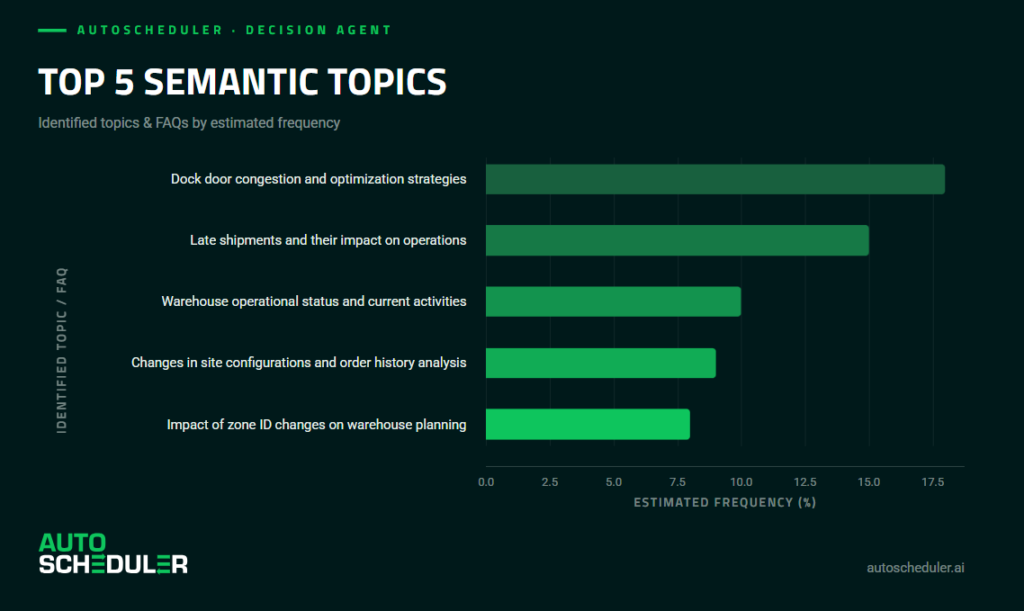
Late shipments dominate the conversation. The words “shipments,” “late,” and “outbound” appear with high frequency across sessions, and the semantic patterns confirm it: users are asking the agent to help them reason about what happens when inbound freight does not arrive as planned, how to reprioritize dock assignments, and how to protect outbound commitments in a compressed window.
The underlying question is almost always some version of: “Given what just changed, what is the best decision I can make right now?” That is a warehouse labor scheduling and dock scheduling optimization problem, and it is one that traditional software tools handle poorly because they were built around static plans rather than dynamic decision-making.
Dock Door Congestion and Yard Management
The agent’s semantic analysis reveals that dock door congestion is the single most frequent physical bottleneck category in customer queries. Operators are asking about how to sequence arrivals, how to reduce trailer detention costs, how to optimize yard management when multiple carriers are competing for limited dock access, and how to reduce the downstream labor disruption that dock congestion creates.
This is a category where the cost of poor decisions is immediate and measurable. Trailer detention fees accumulate by the hour. Labor plans built around an expected dock sequence fall apart when that sequence changes. The agent is being used as a real-time reasoning partner to navigate exactly this kind of cascading constraint.
For teams struggling with dock congestion solutions, the agent connects yard state, carrier timing, labor availability, and outbound priorities into a single decision surface.
Labor Planning and Productivity
The labor and productivity category is the other major cluster. Users are asking about labor allocation across shifts, how to absorb inbound volume spikes without triggering overtime, how to match labor to wave sequences as conditions change, and how to reduce the reactive firefighting that consumes supervisor time on peak days.
Warehouse labor shortage solutions and the ability to reduce warehouse overtime are among the highest-intent topics in the logistics technology space right now, and for good reason. Labor is the largest variable cost in most distribution operations, and it is also the hardest to optimize dynamically. The agent’s ability to reason across labor availability, incoming workload, and operational constraints is one of its most actively used capabilities.

A Signal Worth Watching: The Demand for Explainability
One of the more telling themes to emerge from customer interactions is the frequency with which users ask about the agent’s reasoning, not just its recommendations.
Users want to understand the objective function of the AutoScheduler solver. They want to know why a particular labor allocation was recommended, what constraints drove a specific dock sequencing decision, and how the agent would respond if a key input changed.
This is not just intellectual curiosity. It reflects a real organizational need: warehouse managers are accountable for the decisions made on their floor. They need to be able to explain those decisions to their operations directors, their carrier partners, and their own teams. An AI recommendation that arrives without explanation is one that is difficult to act on confidently.
This is precisely why we invested in explainability as a core capability of the agent. When the system recommends a labor reallocation or a dock door reprioritization, it now surfaces the reasoning behind that recommendation in plain language. Operators get the decision and the logic. That combination is what turns AI output into operational confidence.
Voice Recognition: Meeting the Floor Where It Is
One pattern from the adoption data is worth addressing directly: the transition from text-only interaction to voice-enabled sessions reflects a real shift in who is using the agent and how.
Warehouse floor environments are not desk environments. Team leads, dock supervisors, and operations managers spend their time on the move. The addition of voice recognition to the Warehouse Decision Agent is designed to remove the friction between having a question and getting an answer. You do not need to stop, find a terminal, and type. You ask, and the agent responds.
The progression from launch to voice-enabled interactions represents a meaningful step in making AI decision support genuinely operational rather than primarily analytical.
What Adoption Tells Us About Where the Market Is Headed
The adoption patterns emerging from the Warehouse Decision Agent are consistent with a broader shift in how warehouse operations teams think about software. The legacy model, where a WMS handles execution and humans handle every judgment call that falls outside predefined rules, is not scaling with the complexity of modern supply chains.
The concept of an AI reasoning layer for WMS is moving from category-defining language to buyer-expected capability. Teams that have used the agent to navigate a major carrier disruption, collapse a labor planning cycle from hours to minutes, or reduce trailer detention fees through smarter dock sequencing are not evaluating whether AI decision support is valuable. They are evaluating how much further they can extend it.
The questions being asked of the agent today, covering dock scheduling optimization, warehouse labor planning, supply chain disruption management, and real-time wave sequencing, are also the questions that define competitive separation in distribution. The warehouses that can make better decisions faster, and understand why those decisions are correct, will operate at a structural advantage over those that cannot.
The Road Ahead: Capabilities the Market Is Pulling For
The customer interaction data is a useful forward-looking signal as well. The concentration of queries around explainability, labor optimization, and dock management tells us where the agent’s capabilities need to continue developing.
Several themes point toward clear product directions: deeper integration with carrier data for proactive disruption management, more granular labor utilization modeling, tighter connection between dock scheduling software and yard management optimization, and continued expansion of the explainability layer so that every recommendation comes with the reasoning a manager needs to act on it.
The agent is also surfacing a real appetite for what might be called warehouse decision intelligence at the enterprise level: the ability to look across multiple sites, identify patterns in disruption, and surface optimization opportunities that no individual site manager would have the bandwidth to see.
Meet the Warehouse Decision Agent
The Warehouse Decision Agent is available to AutoScheduler customers today. Since its launch last year, it has been continuously updated with new capabilities, including the explainability features and voice recognition described above, with more on the roadmap based directly on how teams are using it.
The Warehouse Decision Agent is the entry point to the Warehouse Decision Intelligence Platform, AutoScheduler’s full toolbox of analytics built on top of years of domain expertise that makes your warehouse more efficient, improves service and reduces cost. Whether you are solving dock congestion, labor planning complexity, or the broader challenge of running a modern warehouse on top of a WMS that was not built for real-time decision-making, the platform is where those problems get solved.
Try the Warehouse Decision Agent for Free: https://autoscheduler.ai/agent-gate/