Last week, I had the pleasure of taking the stage at the Gartner Supply Chain Symposium & Xpo alongside Kandi Crowe Burkhart, Senior Director of Distribution at Kellanova. Our presentation focused on a critical challenge: maintaining high performance through massive corporate transitions. For Kellanova, this meant executing a seamless AI integration and warehouse orchestration strategy during a high-stakes spinoff from Kellogg’s.
For supply chain leaders looking to leverage decision intelligence and supply chain automation, here are the three biggest takeaways from our session on driving operational excellence across a complex 3PL network.
1. Moving Beyond Tribal Knowledge to Standardized Work
One of the most poignant points Kandi made during our talk was about the role of the “tasker”. In most warehouses, the person responsible for divvying up work is the “quarterback” of the operation, but they often rely on tribal knowledge, unwritten rules that do not scale and cannot adapt to real-time volatility.
By integrating AutoScheduler, Kellanova is moving toward a standardized playbook:
- Standardizing Work: Inconsistent, manual tasking processes are replaced with dynamic AI models that respond to real-time shifts in demand and labor.
- Unlocking Talent Potential: Automating complex decision-making allows high-value employees to move beyond repetitive tasker roles and pursue career growth within the organization.
- Ecosystem Alignment: The platform acts as a “single source of truth,” bridging the gap between Kellanova, 3PL partners, carriers, and end customers.
2. Visibility into Plan Execution: Measuring Against Optimal
Traditionally, supply chain analytics and 3PL success are measured by looking in the rearview mirror at past performance. We discussed how Kellanova transitioned from outcome-only reporting to using the Site Compliance Dashboard.
Before this shift, outcomes were measured, but the “plan execution” was invisible. Now, Kellanova measures site performance against optimal performance, what the math says could have been achieved, rather than just historical averages. This allows leadership to spot “bleeding edge” issues like detention fees and overtime before they impact the bottom line.
3. Proven Network Impact and ROI
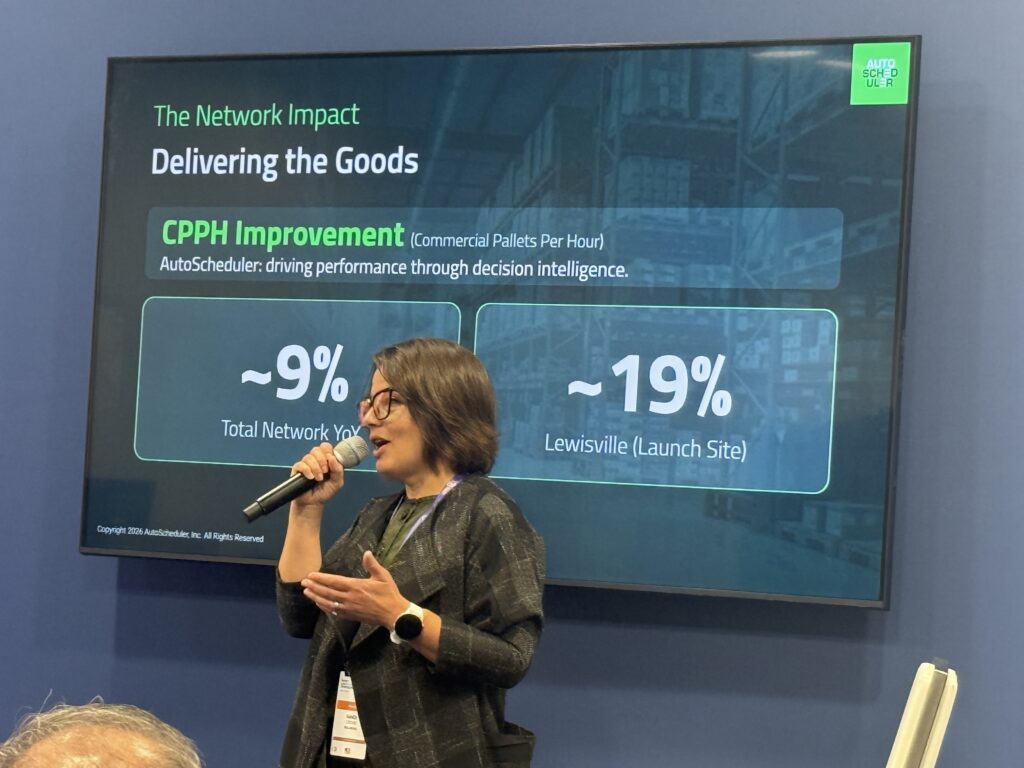
We highlighted that this digital transformation is delivering measurable ROI across the Kellanova North American distribution network. The implementation of decision intelligence has led to significant improvements in Commercial Pallets Per Hour (CPPH) and on-time shipment (OTS) metrics.
Key Performance Results:
- Network-wide Growth: A total network year-over-year CPPH improvement of approximately 9%.
- Launch Site Success: The Lewisville pilot site saw a CPPH improvement of approximately 19%.
- Operational Efficiency: Improved ability to plan 24–48 hours ahead using straight time instead of costly overtime.
Overcoming the “Reality of AI” Through Change Management
A major theme of our 18-month journey was that AI in supply chain is not a “day-one magic fix”. It requires rigorous change management and a culture of trust. Kandi emphasized that for technology to succeed, operators on the floor must have a voice in the tool’s development. This feedback loop led to the inclusion of critical features like reason codes and delay functions to handle real-world warehouse constraints.
As Kandi noted during our wrap-up, this journey is about more than just technology; it is about how teams grow and evolve to responsibly scale AI. By leaning into warehouse orchestration, Kellanova has turned corporate complexity into a competitive advantage.
Stop firefighting and start orchestrating. The same logic that helped Kellanova scale through a massive spinoff is now available as a personal coordinator for your site leaders.
Try the Warehouse Decision Agent your sidekick for daily coordination. See how it handles travel waste, zoning, and labor gaps in real-time.